Press, Pull, Resist: The Southeast Asian Printmakers Turning a Colonial Tool Against the Empire That Built It
There's a particular kind of irony that artists love to weaponize. The printing press arrived in much of Southeast Asia inside the colonial project — Dutch, British, Spanish, French administrators all understood, early and clearly, that controlling what got printed meant controlling what people believed was real. Proclamations. Tax rolls. Racial taxonomies. Religious conversion materials. The press was infrastructure for erasure.
So what does it mean that, right now, printmakers across Indonesia, the Philippines, Vietnam, and Malaysia are among the most politically alive artists working anywhere in the region? It means the tool got flipped. And it's been a long time coming.
The Archive They Tried to Bury
Before European contact, visual reproduction in Southeast Asia wasn't absent — it was just different. Batik resists, carved wooden stamps, woven pattern systems: these were all technologies of repetition and transmission, ways of moving image and meaning across bodies and generations. Woodblock printing existed in the region with deep roots tied to Buddhist manuscript culture, particularly in Burma, Thailand, and Java. But colonial administrations had little interest in cataloguing indigenous print traditions as art. They were categorized, when they were acknowledged at all, as craft, ritual object, or ethnographic curiosity.
What the colonial press did do was make print feel like power — specifically, European power. And when independence movements began to organize, they understood the assignment. Pamphlets, posters, underground newspapers: the printing press became the nervous system of resistance across the region, from the Philippine Revolution of 1896 to the Indonesian nationalist movement of the 1920s and beyond. Print was already political before most of these artists were born.
What's Happening Right Now
The contemporary wave is different from its predecessors in one key respect: it's not underground anymore, and it doesn't want to be.
Artists like Agan Harahap and the broader community of printmakers connected to Yogyakarta's thriving studio scene in Indonesia are making work that moves between gallery walls and open-air markets without apologizing for either context. In the Philippines, collectives operating out of Manila and Cebu are producing linocut editions that engage directly with ongoing land rights struggles, extrajudicial violence, and the particular grief of a country that has been colonized by three different empires and is still working through the paperwork.
In Vietnam, a younger generation is returning to traditional woodblock techniques — tranh dân gian, folk print traditions associated with specific villages like Đông Hồ and Hàng Trống — not as nostalgic recreation but as living language. The imagery updates. The technique stays. The conversation between past and present is the whole point.
Malaysian printmakers, meanwhile, are doing something particularly sharp with screen printing: using the medium's capacity for bold, flat color and high-contrast graphics to make work that reads like protest poster and gallery piece simultaneously. It hangs on a wall in Kuala Lumpur. It also ships to a buyer in Portland. Both things are true.
Why Printmaking, Why Now
Ask any of these artists why printmaking and the answers cluster around a few recurring themes.
Reproducibility is one. A painting is one object owned by one person. A print edition of fifty means fifty people carry the image into their homes, their lives. For artists whose work engages with collective memory, collective grief, collective resistance, that multiplication isn't a compromise — it's the entire logic of the form.
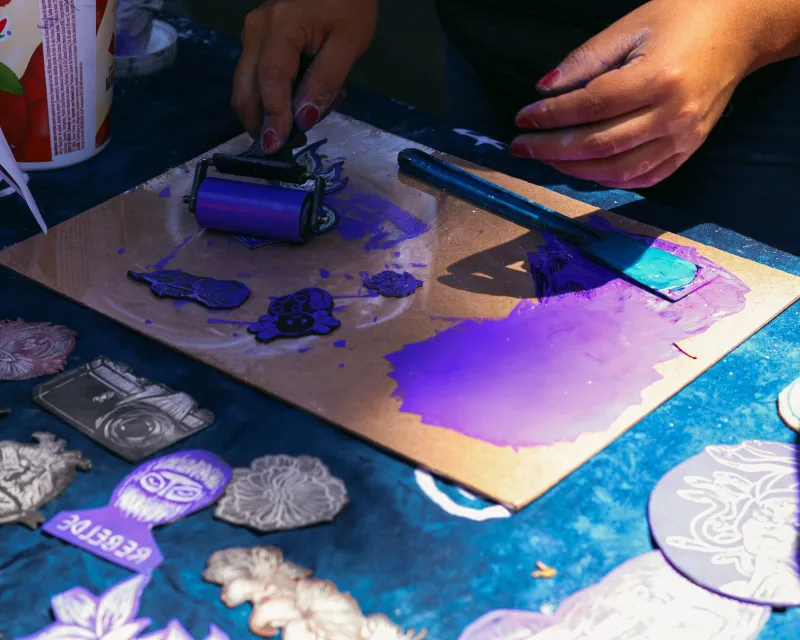
Accessibility is another. Printmaking doesn't require the capital overhead of, say, ceramics or metalwork at scale. A linocut setup is genuinely affordable. Screen printing can be done in a spare room. This matters enormously in economies where art school training is expensive and gallery representation is gatekept by a small number of institutions with their own complicated relationships to the colonial past.
And then there's the tactile, physical fact of the print itself. In an era when most visual culture exists as pixels on a screen — infinitely copyable, infinitely disposable — a hand-pulled print carries weight in the literal sense. You can feel the ink sitting on the paper. You can see the grain of the block in the texture of the image. That materiality is a kind of argument. It says: this was made by a human body, in a specific place, at a specific moment in history.
Cutting Out the Gallery, Finding the Buyer
Here's where the story gets genuinely interesting for anyone watching the economics of contemporary art.
Southeast Asian printmakers have been early and enthusiastic adopters of direct-to-consumer models that bypass the traditional gallery system almost entirely. Etsy, Instagram, independent webshops, art fairs, zine festivals — these artists are building audiences and revenue streams that don't require the approval of a curator in a white-walled space who may or may not understand what they're looking at.
For a US buyer, this creates a remarkable access point. Work that twenty years ago would have been invisible outside its country of origin — or visible only through the distorting lens of a Western museum's "world art" wing — is now a direct purchase away. And the price points are often genuinely accessible, which is the point. These artists aren't trying to manufacture scarcity. They're trying to spread the image.
There's also a growing diaspora market that the mainstream American art world has been slow to recognize. Filipino-American, Indonesian-American, Vietnamese-American communities across the US are actively seeking out work that speaks to their specific cultural inheritance — and printmaking, with its capacity for affordable editions and easy shipping, is meeting that demand in ways that painting or sculpture simply can't.
The Print Is the Argument
Colonial administrators knew what they were doing when they controlled the press. They understood that what gets printed, what gets reproduced, what gets distributed at scale — that's what becomes real in the public imagination. History. Law. Beauty. Worth.
The printmakers working across Southeast Asia right now understand the same thing, from the other side of the equation. Every edition pulled is a counter-claim. Every image carved into a block or burned into a screen is a small act of insisting that this culture, this history, this face, this landscape — it gets to exist in permanent, reproducible form.
That's not a metaphor. That's the actual function of the medium.
The press is loaded. See what they're printing.