The Needle Is the Pen: Southeast Asian Embroiderers Are Stitching Dissent Into the Fabric of Everything
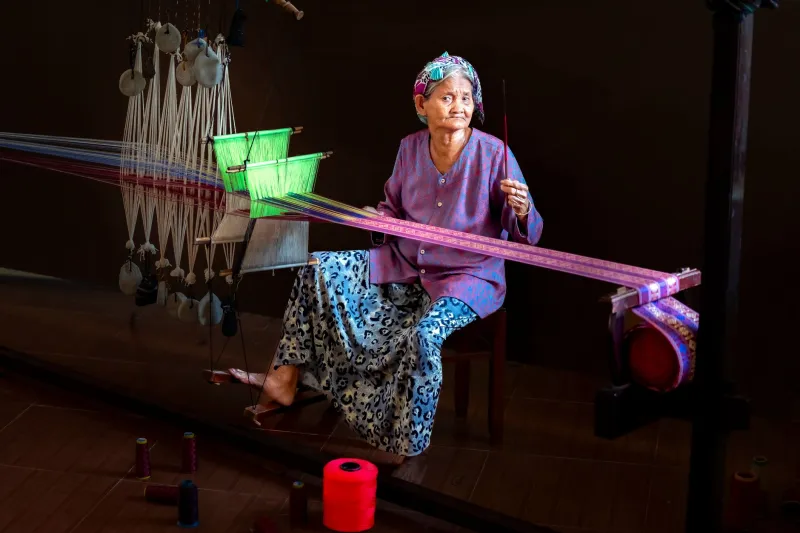
There's a particular kind of irony in the fact that embroidery was, for centuries, used to keep women still. Sit down. Stay inside. Make something pretty. The craft was domesticated on purpose — handed to girls as a substitute for agency, a way to channel energy into something decorative and harmless. In the colonial imagination, the embroidering woman was the compliant woman.
So it tracks, in the most satisfying way possible, that embroidery is now one of the sharpest tools in Southeast Asian activist art. These artists aren't just making pretty things. They're making arguments.
Not Your Lola's Needlework
Start with what's actually happening on the ground. In Manila, artists working in the tradition of calado — the intricate drawn-thread work that's been practiced in the Philippines for generations — are lifting that same technique and using it to stitch phrases lifted from protest chants, queer manifestos, and anti-Marcos slogans into cloth that looks, from a distance, like heirloom fabric. Get close, and the text resolves. The craft is the camouflage.
In Yogyakarta, embroiderers trained in the ornate needlework traditions of the Javanese court are producing pieces that layer queer love narratives over classical motifs — same lotus flowers, same curved vines, but the figures intertwined in them aren't the heterosexual royal couples the pattern books imagined. The visual language reads as traditional. The story it tells is not.
This isn't accidental subversion. It's a deliberate strategy. When your government is watching what you post, when gallery spaces can be pressured, when street art gets painted over — cloth is harder to censor. It travels. It folds. It looks like a gift.
The Colonial Inheritance Problem
To understand why this moment matters, you have to understand what colonialism did to craft. Across the region — whether you're talking about the Dutch in Indonesia, the Spanish in the Philippines, the British in Burma — colonial administration consistently worked to reframe indigenous textile traditions as quaint, feminine, and economically subordinate. Craft was separated from art. Art got the galleries. Craft got the gift shop.
The gendered dimension of that split was never subtle. Weaving, embroidery, textile work broadly — these were coded as women's work precisely because that coding made them easier to dismiss. If the craft belonged to women and women's labor was undervalued, then the craft's cultural significance could be safely ignored. What got lost in that transaction wasn't just prestige. It was the political and spiritual weight that textile arts had carried in pre-colonial Southeast Asian societies — where cloth was currency, ceremony, and communication all at once.
The embroiderers working today know this history. Many of them are explicit about it. They're not just making political art. They're reclaiming a medium that was deliberately stripped of its power.
Coding in Plain Sight
One technique that keeps coming up in conversations with artists across the region is what some of them call embedded text — political messages, names of disappeared activists, queer declarations — worked into patterns in ways that require cultural literacy to decode. A phrase stitched in Baybayin, the pre-colonial Filipino script, inside a design that looks purely ornamental. A series of color combinations drawn from protest flag palettes, arranged in a floral motif.
The double-readability is the point. For audiences who know what they're looking at, the message lands with full force. For audiences who don't, the piece reads as beautiful and traditional. It's a form of protection and a form of invitation at the same time. You see it when you're ready to see it.
This strategy has a long history in marginalized art-making. American quilters used pattern to communicate during the Underground Railroad era — a claim that historians still debate but that has become deeply embedded in cultural memory. Enslaved people across the Americas encoded meaning into textile work as a matter of survival. The Southeast Asian embroiderers doing similar things today aren't necessarily drawing a direct line to those traditions, but they're operating from a recognizable logic: when the official channels are closed, you find the ones that look like decoration.
Making It to American Walls
What's interesting from a US perspective is how this work is landing in gallery contexts here. A handful of Southeast Asian embroidery artists have shown in New York and Los Angeles over the past few years, and the reception has been notably different from the way Western audiences used to engage with textile art from the region — which was mostly through the lens of ethnographic curiosity or fashion-world exoticism.
American audiences, particularly in activist and queer communities, are increasingly reading this work through a political frame. The craft's domestic associations — which in the Southeast Asian context were part of the colonial diminishment — actually resonate differently here, where the feminist reclamation of traditionally "feminine" crafts has been a live conversation for decades. Groups like the Craftivism movement have primed US audiences to see needlework as a site of political meaning. That cultural groundwork makes it easier for Southeast Asian embroidery artists to walk into American spaces and have their work understood on something closer to its own terms.
It's not a perfect translation. The specific histories, the coded scripts, the regional political contexts — a lot of that nuance gets lost for audiences who don't have the background. But the core proposition, that this is serious political art made by people with serious things to say, is landing.
The Craft Doesn't Apologize
What strikes you most, talking to artists in this space, is the absence of defensiveness. An earlier generation of Southeast Asian artists working in traditional craft forms often had to spend enormous energy justifying their medium — arguing, essentially, that embroidery was a legitimate vehicle for serious ideas. That argument feels less necessary now, at least within the communities where this work circulates.
The artists aren't asking permission to be taken seriously. They're just working. The thread goes in, the pattern builds, the message accumulates stitch by stitch. By the time you're looking at a finished piece, the argument has already been made. You can agree with it or not, but you can't pretend it isn't there.
That's the thing about cloth. It holds its shape. It keeps its color. It survives.
A government can take down a mural. A platform can delete a post. But a piece of embroidery, folded into a bag and carried across a border, is just fabric until the person who made it decides to unfold it and show you what it says.
That's not a metaphor. That's a practice. And it's sharper than it looks.