Mud, Monument, and Meaning: Southeast Asian Ceramicists Are Taking Clay Out of the Gallery and Into the World
There's a particular kind of reverence that Western art institutions have assigned to ceramics. The hushed gallery. The spotlit pedestal. The little card that says do not touch. It's a framing that turns clay — one of the oldest, most democratic materials humans have ever worked with — into something precious, protected, and ultimately removed from the people it was always meant to serve.
A growing wave of Southeast Asian ceramicists is done with that framing entirely.
From Kiln to Community
In the Philippines, Indonesia, Vietnam, and Thailand, artists are dragging their practice outside. Not just physically, but philosophically. They're building large-scale clay installations in public parks, collaborating with neighborhood communities to fire vessels in open-air pits, and embedding their work directly into the social fabric of the places they come from. The gallery system — with its gatekeepers, its price tags, and its habit of deciding whose craft gets called "fine art" — isn't the destination anymore. It's barely even a consideration.
Take the work happening in Yogyakarta, Indonesia, where ceramicists have been organizing what they call tanah bersama — shared earth — sessions. These aren't workshops in the hobbyist sense. They're collective firing events built around pre-Islamic Javanese ritual, where the kiln itself becomes a communal act. Neighbors show up. Kids get their hands dirty. The finished pieces don't go to auction. They stay in the neighborhood — installed in community gardens, embedded in walls, placed at the mouths of alleys. The art lives where the people live.
It's a model that would make a lot of MFA programs deeply uncomfortable, and that's kind of the point.
The Politics Baked In
Clay carries memory. That's not a metaphor — it's material science. Fire transforms earth into a record that can outlast almost everything else. Southeast Asian ceramicists working in this public, communal mode are acutely aware of that durability, and they're using it deliberately.
In Vietnam, artists working in the tradition of Bát Tràng — a ceramic village outside Hanoi with over 500 years of history — are reinterpreting traditional motifs in large-scale public murals that speak directly to contemporary land rights struggles. The imagery isn't abstract. Dragons and lotus flowers are rendered at ten-foot scale on the walls of communities facing displacement from rapid urban development. The message is architectural: we were here, we are still here, and this wall will outlast whoever is trying to move us.
In the Philippines, ceramic artists have been collaborating with Indigenous Lumad communities in Mindanao, creating monumental clay works that document oral histories and ancestral land boundaries — knowledge that exists in living memory but rarely in any form that colonial legal systems recognize. Firing that knowledge into permanent form is, in this context, a profoundly political act.
This is what happens when ceramics stops being about the object and starts being about the argument.
Blowing Up the Precious Object Myth
Part of what makes this movement so sharp is how directly it challenges Western assumptions about what ceramic art is supposed to look like. The dominant aesthetic that gets celebrated in American art media tends toward the refined — smooth glazes, delicate forms, work that signals mastery through restraint. It's beautiful, often. But it also carries a very specific cultural bias about what "skill" looks like in clay.
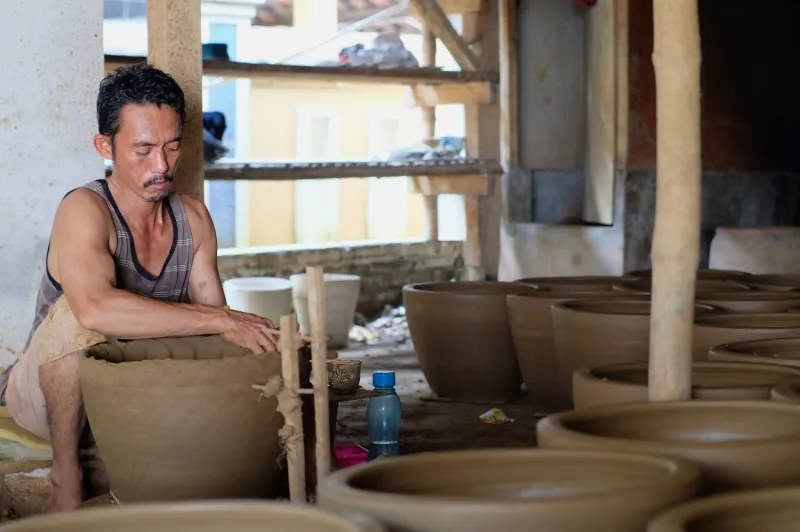
The Southeast Asian artists pushing into public space are doing something deliberately rougher. Coil-built forms that show the hand. Surfaces that record the weather they were fired in. Cracks left intentional, not repaired. Scale that makes delicacy impossible. It's a rejection of preciousness as a value system, and it reads as a direct challenge to the Western gallery's habit of domesticating non-Western craft traditions by smoothing their edges until they fit comfortably on a shelf.
There's also something worth noting about the firing techniques being revived. Pit firing, anagama-adjacent open kilns, wood-fire methods tied to specific regional traditions — these aren't just aesthetic choices. They're a reclamation of technical lineages that were disrupted by colonialism, by the imposition of industrial production, and by the long process of convincing artisans that the "proper" way to make ceramics was the European way. Choosing to fire in an open pit isn't nostalgia. It's a curriculum.
What This Looks Like in the US
For American audiences, this work is increasingly accessible — not just through art fairs, but through diaspora communities and cultural organizations in cities like Los Angeles, Seattle, and New York that have significant Southeast Asian populations. Filipino American community centers in the Bay Area have hosted collaborative ceramic events modeled on the tanah bersama format. Indonesian artists on residency in the US have installed public clay works that pull directly from the tradition they're building back home.
If you're used to thinking about ceramics through the lens of, say, a high-end Brooklyn pottery studio or a Scandinavian minimalist bowl that costs $200, this work is going to recalibrate something. It's messier. It's louder. It takes up more space — literally and conceptually — than ceramics is usually allowed to.
That's not a bug. That's the whole project.
The Knife in the Clay
Pisau means knife, and the metaphor holds here: the sharpest tool in Southeast Asian ceramics right now isn't a sculpting loop or a trimming blade. It's the decision to stop asking for permission. Permission to show in galleries. Permission to be called fine art. Permission to make work that's political, communal, and built to be touched.
These artists aren't shattering the pottery wheel because they don't know how to use it. They know exactly how to use it. They just have bigger things to build.
The earth is patient. The fire is ready. And the walls of cities across Southeast Asia — and increasingly, across the US — are getting covered in something that will be very hard to ignore and even harder to erase.