Fifteen Seconds of Shadow: The Puppet Artists Smuggling Wayang Into Your For You Page
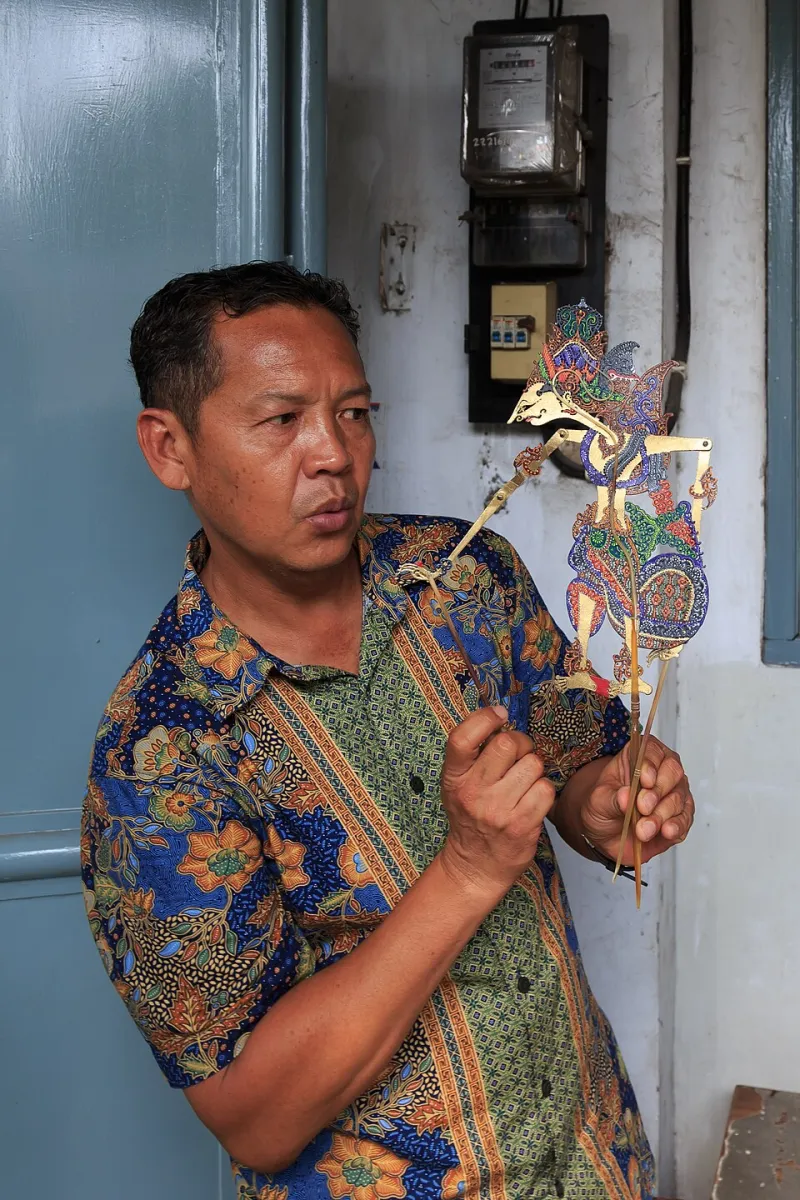
Photo: CEphoto, Uwe Aranas, CC BY-SA 3.0, via Wikimedia Commons
There's a clip that's been making the rounds lately. A single leather puppet — intricately carved, gilded at the edges — dances against a backlit screen while a voice narrates in clipped, punchy Javanese with English subtitles rolling underneath. The story is ancient: Arjuna facing a moral crisis before battle, the kind of existential weight that philosophers have unpacked for centuries. The runtime is forty-seven seconds. The comment section is losing its mind.
This is wayang kulit in 2024, and it looks nothing like what your high school world cultures textbook described.
The Old Art, The New Feed
Wayang kulit — the Indonesian shadow puppet tradition that stretches back over a thousand years — has always been a living art form. It absorbed Hindu epics, Islamic mysticism, Dutch colonial anxiety, and post-independence nationalism without losing its spine. But the jump to social media is something different. It's not just a new venue. It's a new grammar.
Traditional wayang performances, called pagelaran, run anywhere from six to nine hours. A dalang — the puppeteer and storyteller — doesn't just move figures behind a cloth screen. They voice dozens of characters, conduct a live gamelan orchestra, and hold an entire village's cosmology in their hands for a single night. It's a total experience, spiritual and communal in ways that don't compress easily.
So what happens when you try to compress it anyway?
For a growing cohort of young puppeteers across Java, Bali, and increasingly in diaspora communities in the US and Netherlands, the answer is: something genuinely interesting. Not a lesser version of the real thing — something adjacent, something that uses the original as raw material rather than sacred text.
Cut to the Chase, Keep the Soul
Young creators working in this space talk a lot about the difference between form and essence. The form — the nine-hour runtime, the full gamelan accompaniment, the ritual context — isn't always portable. The essence — moral complexity, dark humor, gods behaving badly, heroes who make terrible decisions — translates with surprising ease.
Comedy is doing a lot of the heavy lifting here. Short-form wayang content that leans into the absurdist elements of the epics — and there are many, because the Mahabharata and Ramayana are genuinely weird stories full of shape-shifting, divine manipulation, and morally dubious choices — tends to explode. A clip reframing the Pandava brothers as competitive siblings arguing over group chat dynamics. A Garuda who's clearly having a bad day. Shiva rendered as the kind of deity who says one thing and means another.
This isn't disrespect. It's the same interpretive freedom that dalangs have always exercised. The tradition has never been a museum piece — it's always been responsive to its audience. The audience just happens to live on TikTok now.
The Diaspora Dimension
For Indonesian and Southeast Asian communities in the US, these clips are doing something emotionally complicated and culturally significant. They're a point of contact with something that many second-generation kids grew up hearing about but never fully accessed — either because they didn't speak the language fluently enough to follow a full performance, or because the full performance simply wasn't available where they lived.
A forty-seven-second clip with English subtitles is a door that wasn't there before. It's not the whole house, but it's a door.
Creators who are conscious of this dynamic often build in layers — something that rewards casual viewers with the joke or the visual spectacle, and rewards deeper viewers with mythological context, traditional technique, or deliberate callbacks to classical iconography. The leather puppets themselves carry centuries of visual language. Even a non-expert viewer in Des Moines can sense that what they're looking at has weight, even if they can't name it.
What Gets Left on the Cutting Room Floor
It would be dishonest to pretend nothing is lost. The ritual dimension of wayang — its function as a medium between the human and the divine, its role in village ceremonies, its capacity to hold collective grief and celebration — doesn't fit in a phone screen. Dalangs who've spent decades mastering the full form sometimes watch these clips with complicated feelings. Not hostility, exactly. More like the feeling of seeing a condensed book adaptation of something you love. Grateful it exists. Aware of what's missing.
The communal experience is the hardest thing to replicate. A traditional wayang performance is something you attend with your body, in a space, surrounded by other people for whom this story is also their story. Social media is, by design, an experience of isolated individuals who happen to be watching the same thing at different times in different rooms. The algorithm connects them statistically. It doesn't make them a community in the same way.
But here's the thing: creators are working on that too. Live streams with real-time Q&A. Comment sections that function as genuine conversation. Collaborative duets between puppeteers in Jakarta and diaspora artists in LA. The form is being invented in real time, and it's more thoughtful than you'd expect from a platform that also hosts raccoon videos.
The Longer Game
The most compelling argument for what these creators are doing isn't about TikTok at all. It's about pipeline. Young people who encounter wayang through a thirty-second clip sometimes go looking for more. They find longer YouTube performances. They find academic resources. Some of them — not many, but some — end up at actual performances, or start learning puppetry themselves.
The short-form content isn't replacing traditional wayang. It's advertising it to people who didn't know they were in the market. In a cultural moment when attention is the scarcest resource and heritage arts are competing with everything else for a slice of it, that's not nothing. That's actually a pretty sharp strategy.
The shadow has always needed a light source to exist. These creators are just using a different bulb.
And honestly? The puppets look incredible on a phone screen. All that intricate leather carving, all that gold leaf detail — it pops in a way that low-resolution temple footage never quite managed. The art form was always visual. The platform just finally caught up to it.