Cut Out the Middleman: How Indonesian Batik Makers Are Building Their Own Lane to American Closets
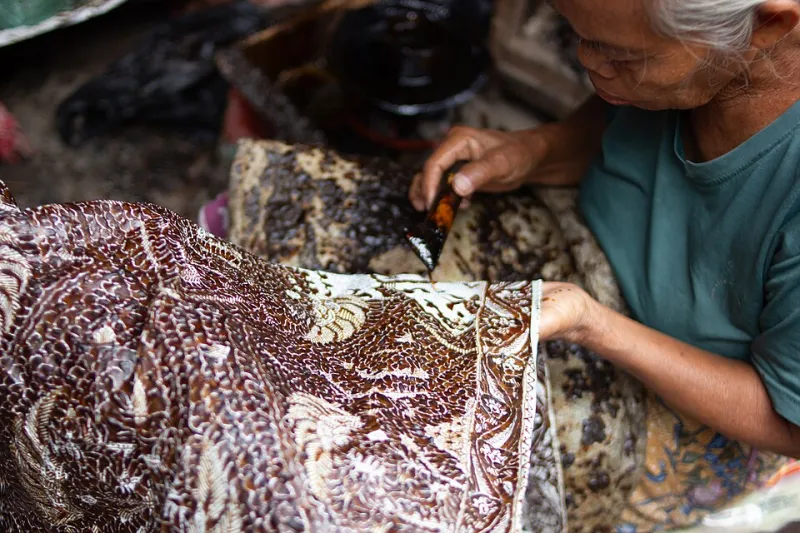
Photo: Ahaetulla, CC BY-SA 4.0, via Wikimedia Commons
For decades, the path batik took from an Indonesian workshop to an American wardrobe was long, opaque, and financially punishing to the people who actually made it. Fabric would pass through export brokers, importers, wholesale distributors, and retail markups that left the original artisan with a fraction of the final price — if they were lucky enough to be in that supply chain at all. Most weren't.
That system is cracking. And the people doing the cracking are younger batik makers with smartphones, Shopify stores, and a very clear-eyed understanding of what their work is actually worth.
The Platform Shift Nobody Saw Coming
When Nadia Kusuma started posting process videos of her batik workshop in Pekalongan — a coastal Javanese city with a batik tradition going back centuries — she wasn't thinking about export strategy. She was just showing people how it was done. The wax resist technique. The dye baths. The hours of hand-drawing that go into a single piece of fabric.
The response from US viewers caught her off guard. "Americans kept asking where they could buy it," she said in a recent Instagram Live. "Not the cheap printed version. The real thing. They wanted to know the story."
That appetite for authenticity is the market signal that a growing number of Indonesian batik artisans are now building businesses around. Platforms like Instagram, TikTok, and Etsy have collapsed the distance between maker and buyer in ways that the traditional export industry structurally prevented. When a customer in Portland or Atlanta can watch a video of the exact hands that made the piece they're about to purchase, the whole transaction changes character.
Pricing Power Is the Revolution
Here's the part that matters most: when you cut out four layers of intermediaries, the artisan captures more of the sale price. But it's not just about margin. It's about being able to price honestly in the first place.
Under the old export model, Indonesian batik was often positioned as a budget "ethnic textile" — something sold at the lower end of the market because that's where importers placed it. The irony is brutal, given that authentic hand-drawn batik tulis (the most labor-intensive form, where every line is applied with a handheld canting tool) can take weeks to produce a single piece.
Selling direct means artisans can price for the actual labor involved and find buyers who understand what they're paying for. "I charge what the work costs," says one Yogyakarta-based maker who asked to go by her craft name, Ayu Wulan. "If I sold through a wholesaler, they would tell me that price is too high for the market. Selling directly, I find people who get it."
For American buyers accustomed to fast fashion's race to the bottom, there's a growing counter-culture of consumers actively seeking out exactly this kind of traceable, fairly priced craft. The batik makers are meeting that culture where it lives — on their phones.
Storytelling as Brand Strategy
What separates the artisans gaining real traction in the US market from those who aren't isn't necessarily the quality of the batik — it's the quality of the narrative surrounding it. American consumers, particularly in the demographics most likely to spend on artisan goods, respond to story. Where was this made? By whom? What does the pattern mean?
Batik's symbolic vocabulary is extraordinarily rich. Different regions have distinct visual traditions. Patterns carry meaning — some were historically reserved for royalty, others for specific ceremonies. That depth of meaning is genuinely compelling to buyers who are tired of products with no history attached.
Savvy makers are leaning into this hard. Short documentary-style Reels. Behind-the-scenes TikToks showing the wax-and-dye process. Captions that explain the cultural significance of a particular motif. It's content marketing, yes — but it's also genuine cultural education, and it's working.
The Souvenir Trap and How to Escape It
One of the biggest perceptual hurdles batik has faced in Western markets is what you might call the souvenir problem. For a long time, "batik" in American retail meant machine-printed fabric sold at import shops — a decorative object associated with travel memories rather than everyday fashion. Real batik artisans find this categorization maddening.
The direct-to-consumer movement is actively dismantling that framing. When batik appears on Instagram styled as contemporary fashion — worn as a blazer, a wrap skirt, a statement scarf — rather than displayed as a wall hanging, the perception shifts. Several Indonesian makers have started collaborating with US-based stylists and fashion influencers specifically to reposition the aesthetic.
The goal isn't to erase batik's Indonesian identity — it's to complicate the souvenir narrative by showing the work in motion, in real wardrobes, as a living fashion choice rather than a static artifact.
Keeping It Local
There's a dimension to this story that goes beyond individual business success. When artisans sell direct and capture better margins, that money stays in their communities. It funds apprenticeships. It keeps traditional techniques viable. It gives younger people in batik-producing regions a reason to learn the craft rather than leaving for factory work in the cities.
The digital tools enabling all of this are global, but the impact is intensely local. A Pekalongan workshop that builds a direct customer base in the US isn't just running a successful small business — it's sustaining a piece of Indonesian material culture that has survived colonialism, industrialization, and globalization by constantly reinventing its economic model.
This is what the batik revolution actually looks like: not a gallery show, not a UNESCO designation, not an export report. It's a maker in Central Java going live on Instagram at 7 AM her time — which is 6 PM the night before in New York — and selling out a collection before breakfast.