Their Studio, Their Rules: Southeast Asian Tattoo Artists Are Done Letting Western Gatekeepers Set the Price of Culture
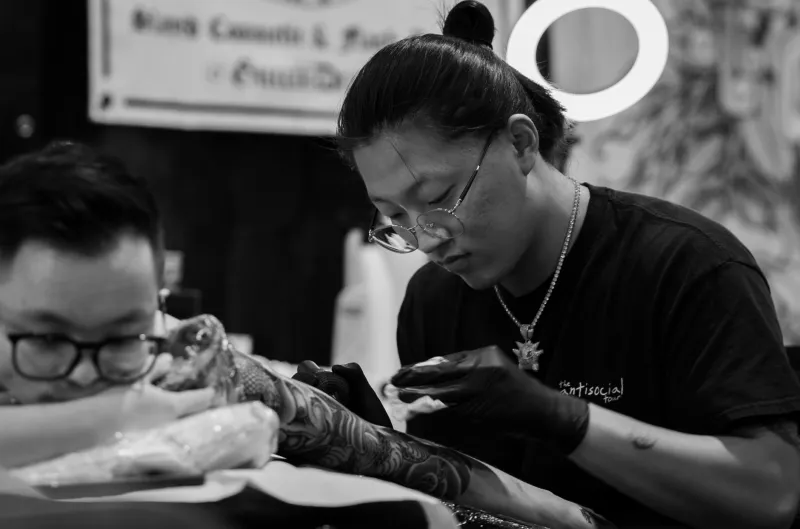
There's a particular kind of exhaustion that comes with being the most interesting person in someone else's room. Southeast Asian tattoo artists working in the United States know it well — the feeling of watching your cultural vocabulary get absorbed into a studio's brand while your cut stays modest and your creative control stays minimal. That arrangement is losing its grip, and the people walking away from it aren't looking back.
This isn't the same conversation as pre-colonial identity reclamation, though that work is happening too and it matters enormously. This is something more structural, more pointed: a direct interrogation of who profits when Southeast Asian tattooing becomes desirable to American consumers, and who decides what counts as skilled, authentic, or worth premium pricing.
The Apprenticeship Trap
The traditional Western tattoo apprenticeship model was never designed with Southeast Asian artists in mind. It was built around a specific lineage — American traditional, sailor flash, biker culture — and the gatekeeping it produces reflects that origin. Artists who come up through Filipino, Indonesian, or Thai tattooing traditions often find themselves pushed to either translate their aesthetic into something more legible to Western clients or accept junior status in shops where their actual expertise is quietly harvested for clout.
Joanna Reyes, who runs a Filipino-owned studio in Los Angeles, describes the dynamic bluntly. She spent two years in a West Hollywood shop where her background in batok — the indigenous hand-tap tattooing of the Cordillera peoples — was a selling point in the studio's Instagram bio but never reflected in her booking rates. "They wanted the story," she says. "They didn't want to pay for the knowledge behind it."
That story-without-compensation model is widespread enough that it's basically a genre. Western studios have become adept at marketing Southeast Asian aesthetic influence while structuring compensation in ways that keep the actual practitioners economically dependent. The apprenticeship system, with its long unpaid or underpaid periods, functions as a filter that favors artists who can afford to wait — which, not coincidentally, tends to mean artists with existing access to capital.
Building the Transpacific Alternative
What's replacing that pipeline isn't a single institution — it's a distributed web of studios, mentorship connections, and direct-to-client relationships that routes around the gatekeepers entirely.
In Seattle, a collective called Tinta Namin operates as both a studio and a training ground, pairing newer Filipino-American artists with practitioners in Manila and Cebu who can offer mentorship grounded in the actual tradition rather than a Western shop's interpretation of it. The model is deliberately transpacific: knowledge flows in both directions, pricing is set collectively, and no single studio owner controls who gets access to clients or training.
In Houston, Indonesian-American artist Dewi Santoso has spent the last three years building a client list exclusively through direct referral and social media — no studio split, no house rules about what styles she's allowed to offer. Her rates reflect the labor of someone with genuine expertise in Dayak-influenced motifs, and her clients, many of them Indonesian diaspora, understand exactly what they're paying for. "When I set my own price, I'm also setting the value of the tradition," she says. "That's not something I'm willing to let someone else decide."
The Pricing Is Political
Money is never just money in these conversations, and the tattoo industry makes that especially legible. When a white-owned studio in Brooklyn charges top dollar for work that draws heavily on Southeast Asian visual traditions — and pays the Southeast Asian artist doing that work a house rate — the economics encode a very specific power relationship. The tradition gets monetized; the practitioner gets managed.
The artists building independent models are explicit about the fact that pricing is one of the sharpest tools they have. Setting a rate that reflects genuine cultural expertise isn't just good business — it's a refusal to let the market undervalue the knowledge embedded in the work. It pushes back against the idea that Southeast Asian aesthetic traditions are a vibe available for appropriation rather than a living body of practice with practitioners who deserve to be compensated accordingly.
This is where the conversation gets uncomfortable for some American consumers who've gotten used to treating Southeast Asian-influenced tattooing as a relatively affordable exotic option. The independent studio model asks those clients to reckon with what they've actually been paying for, and what that pricing has implied about whose expertise counts.
Aesthetic Gatekeeping and Who Gets to Be "Fine Art"
There's another layer to this beyond the economics. The Western tattoo world has developed an internal hierarchy that places certain styles — Japanese neo-traditional, American traditional, hyper-realism — at the top of the prestige ladder, with everything else arranged below according to how legible it is to that framework's judges. Southeast Asian tattooing traditions don't slot neatly into those categories, and artists who work primarily within them often find their work dismissed as "ethnic" or "decorative" rather than technically sophisticated.
The independent studio movement is pushing back on that framing, partly by refusing to seek validation from the institutions that enforce it. Competitions, industry publications, and shop-of-the-year lists produced by Western tattoo media have almost no Southeast Asian representation — and increasingly, the artists doing the most interesting work in this space don't seem particularly interested in chasing those credentials. They're building their own visibility through diaspora networks, Southeast Asian cultural media, and the kind of word-of-mouth that travels through communities rather than through industry press.
That's not resignation. It's a strategic decision about where legitimacy actually comes from and who gets to grant it.
What Comes Next
The transpacific studio model is still young and still working out its contradictions. Building independent infrastructure is hard, especially for artists without startup capital or established client bases. Not every practitioner has the option to walk away from a studio split, even a bad one. And the social media platforms that have been essential to building direct-to-client relationships come with their own set of extractive dynamics.
But the direction is clear. Southeast Asian tattoo practitioners in the US are increasingly uninterested in a deal where they provide the cultural depth and someone else captures the value. They're building the rooms they want to be in — and they're setting the terms for who gets invited.
That's not a niche development in a subculture. It's a model for how creative communities can resist extraction while staying rooted in the traditions that make their work worth anything in the first place. The needle, in this case, is drawing a boundary. And it's doing it in ink that doesn't wash out.