Script Revolution: The Southeast Asian Calligraphers Writing Their Ancestors Back Into Existence
There's a particular kind of violence that doesn't leave bruises. It happens when a language is stripped of its visual form — when the shapes a culture used to record its prayers, its debts, its love letters, its laws, get replaced wholesale by someone else's alphabet. Colonial administrators across Southeast Asia understood this intuitively. Suppress the script, and you go a long way toward suppressing the people who read it.
What they didn't count on was the ink drying slowly.
Across the region — and increasingly in diaspora communities in cities like Los Angeles, Chicago, and New York — a loose but fiercely motivated movement of calligraphers is bringing indigenous writing systems back to life. Not as museum pieces. Not as tourist logos. As living, breathing, evolving art forms that have something urgent to say about identity, sovereignty, and who gets to decide what written language looks like.
The Scripts That Weren't Supposed to Survive
Baybayin, the pre-colonial script of the Philippine archipelago, was never fully killed — but it was buried deep. Spanish colonizers arrived in the 16th century and systematically replaced it with the Latin alphabet, a project so thorough that by the 20th century most Filipinos had never seen their ancestral letterforms. Today, Baybayin shows up on Philippine peso bills and government seals, which is either a reclamation or a irony, depending on who you ask.
Javanese script — Hanacaraka — fared somewhat better, surviving in traditional shadow puppet texts and royal court documents, but was progressively sidelined by Dutch colonial education systems that prioritized Latin orthography. Balinese script clung on in sacred lontar palm manuscripts. Old Khmer script, the ancestor of modern Cambodian writing, persists in temple inscriptions but has largely been displaced in everyday use by its simplified descendant.
Each of these scripts carries within its curves and strokes an entire cosmology — philosophical systems, religious frameworks, ways of organizing knowledge that don't map neatly onto Western linguistic structures. When you lose the script, you lose more than letters. You lose a way of thinking.
Calligraphy as Counterculture
Meet the people who are done with that loss.
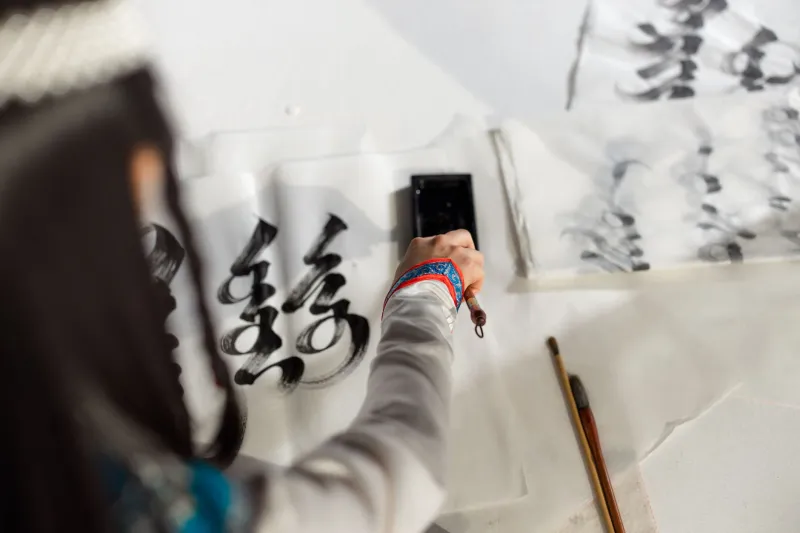
In Manila, calligraphers and lettering artists are integrating Baybayin into contemporary graphic design, tattooing, and street murals. Some are working with linguists to develop standardized digital fonts; others are deliberately keeping their practice handmade and idiosyncratic, arguing that the variation is the point. "Baybayin was never meant to look the same every time," one Manila-based artist explained in a recent interview. "It was written on leaves with sticks. The impermanence was the message."
In Yogyakarta, Indonesia, a younger generation of Javanese artists is taking Hanacaraka off the temple walls and into contemporary gallery spaces, using traditional brush techniques alongside digital tablets to create work that reads simultaneously as ancient and immediate. Some are collaborating with batik makers to embed script into textile patterns — a layering of traditional forms that creates meaning on multiple levels at once.
In Cambodia, artists working with Old Khmer and its modern derivative are grappling with the additional weight of post-genocide cultural reconstruction. The Khmer Rouge systematically targeted educated people, teachers, anyone who carried specialized knowledge — which means the work of script revival there carries a particularly heavy political charge. Preserving the written form isn't an aesthetic choice. It's an act of repair.
The Digital Dimension
Here's where things get interesting for a US audience trying to follow this story: a significant chunk of this revival is happening online, and diaspora communities are driving a lot of it.
Filipino Americans have been central to the Baybayin revival for years, with designers in the Bay Area and SoCal developing typefaces, building educational apps, and running Instagram accounts that teach the script to thousands of followers who never had access to it through formal schooling. The hashtag ecosystem around Baybayin on social media is genuinely thriving — which is remarkable for a writing system that was functionally suppressed for four centuries.
This digital dimension complicates the nostalgia narrative in productive ways. When a 22-year-old in Daly City learns Baybayin through a YouTube tutorial and then uses it to hand-letter a birthday card for their lola, that's not historical reenactment. That's a living script finding a new context. When a Jakarta-based designer builds a Hanacaraka OpenType font that works across Adobe Creative Suite, that's not preservation — that's evolution.
The tension some traditionalists feel about digitization is real and worth acknowledging. There are legitimate questions about what gets lost when a script that was designed for organic materials gets translated into pixels. But most of the calligraphers working in this space seem less interested in purity than in survival. A script that only lives in archives is a dead script. A script that shows up in your DMs, your sneaker design, your grandmother's birthday card — that one has a pulse.
What Western Letterforms Can't Say
Part of what makes this movement so compelling to watch is the explicit critique embedded in it. These calligraphers aren't just making beautiful objects — they're making an argument.
The argument goes something like this: the dominance of Latin script in global communication isn't neutral. It's a legacy of colonial power that shaped what kinds of knowledge got transmitted, recorded, and valued. When Southeast Asian languages are written in Latin characters, something is always lost in translation — not just phonetically, but conceptually. Indigenous scripts weren't just different ways of spelling the same things. They encoded different ways of organizing thought.
This is the kind of claim that can sound abstract until you sit with it. But spend time looking at Javanese script — its intricate, interlocking syllabic structure — and you start to feel what it might mean to think in a form that doesn't default to the linear, left-to-right march of Western text. The visual logic is different. The cognitive experience of reading is different. That difference matters.
The Ink Is Still Wet
None of this is happening in a vacuum. Script revival movements exist alongside broader conversations about linguistic sovereignty, indigenous rights, and the long tail of colonialism — conversations that are very much alive in the US, where debates about language, identity, and representation are constant background noise.
For Southeast Asian communities in America, the calligraphy revival offers something specific: a way to connect with cultural heritage that doesn't require fluency in a spoken language. You can learn to write Baybayin without speaking Tagalog. You can study Hanacaraka as a visual art form before you tackle the grammar. The script becomes an entry point, a handhold on a heritage that distance and diaspora have made slippery.
That's not a small thing. In a country where assimilation pressure is relentless and cultural visibility is hard-won, having a visual language that is unmistakably, defiantly yours — that says we were writing before you got here — carries real weight.
The calligraphers know this. That's why they keep picking up the brush.