Every Groove Tells a Ghost: How Southeast Asian Woodcarvers Are Turning Endangered Folklore Into Permanent Form

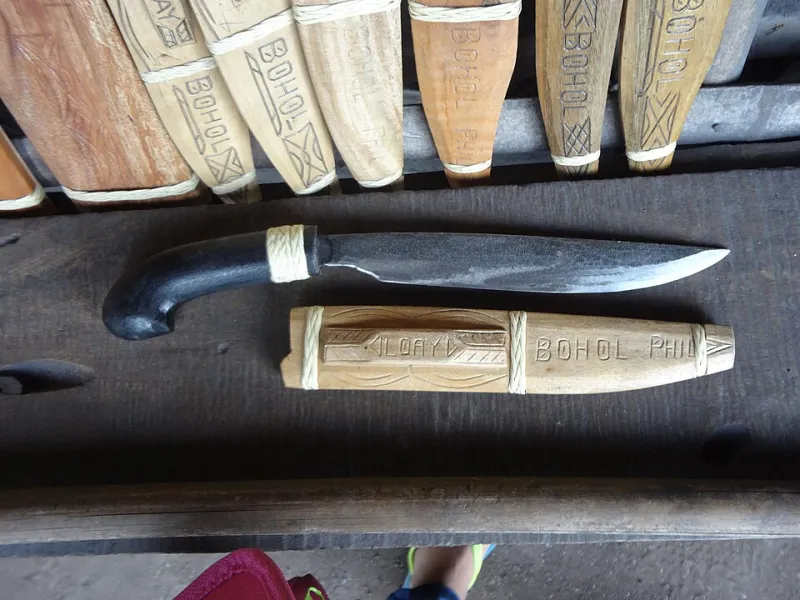
Photo: CEphoto, Uwe Aranas, CC BY-SA 3.0, via Wikimedia Commons
There's a story living inside a block of teak that most people will never read. Not because it's hidden, exactly — but because you have to know what you're looking at. The spiraling motif along the base isn't just ornamental. It's a river spirit. The figure with the asymmetrical hands isn't a mistake. It's a warning. And that cluster of leaves pressed into the upper left corner? That's the part of the story your grandmother would have whispered, not spoken aloud.
Woodcarvers across Southeast Asia have always known this. The difference now is that a younger generation of artists — many of them trained in both traditional craft and contemporary art practice — are being deliberately, urgently intentional about it. Because the elders who carry the oral versions of these stories are aging out, and the window to translate them into something permanent is closing fast.
The Archive Problem Nobody's Talking About
When people in the US think about endangered languages or disappearing oral traditions, the conversation usually gravitates toward recordings — field audio, documentary films, university linguistics archives. Digital preservation. All of that matters. But there's a specific kind of knowledge that lives in the telling of a story — in gesture, in tone, in the physical presence of a narrator — that a microphone can't fully capture.
Woodcarving, it turns out, offers something different. A carved object doesn't just record a story. It embodies it. It takes up space. It can be touched, inherited, placed on a shelf in an apartment in Los Angeles or Houston and still carry the full weight of the culture it came from.
This is exactly the logic that drives artists like Balinese carver I Wayan Suartha, who has spent the last decade working with village elders in the Kintamani region to document local mythologies that aren't written down anywhere — stories about the origin of specific rivers, about ancestral figures who mediated between the living and the dead, about agricultural rituals that predate the Hindu-Buddhist synthesis that most Westerners associate with Balinese culture. He carves these narratives into panels that function almost like illustrated manuscripts, except the "pages" are three feet of mahogany and the "text" requires a knowledgeable reader to decode.
"Writing things down flattens them," he's said in interviews. "Carving preserves the dimension."
Vietnam's Narrative Panels and the Diaspora Market
In central Vietnam, particularly around Hội An and the surrounding villages, woodcarving has historically been tied to temple architecture — decorative, yes, but also deeply communicative. The figures carved into communal halls weren't aesthetic choices. They were theological arguments, cosmological maps, community histories compressed into visual form.
What's happening now in workshops around Đà Nẵng is a conscious revival of that communicative function, applied to secular folklore. Younger carvers — some of them formally trained, others apprenticed through family lineages — are producing work that documents the Truyện Cổ Tích tradition: Vietnamese fairy tales and folk stories that exist in dozens of regional variants, many of which have been steamrolled by standardized national curricula that favor a single "official" version.
The market for this work, interestingly, skews heavily toward the Vietnamese-American community. Galleries in Orange County and San Jose have reported consistent demand for pieces that carry specific regional identifiers — not generic "Vietnamese art" but work that signals which Vietnam, whose grandmother's version of the story. For second- and third-generation diaspora communities, these objects function as a kind of cultural GPS. They point back to somewhere specific.
Thailand's Northern Carving Schools Are Quietly Radical
Chiang Mai has long been known as Thailand's craft capital, and its woodcarving tradition runs deep — particularly in the northern Lanna style, which is visually distinct from the central Thai aesthetic most tourists encounter in Bangkok. What's less discussed is how several carving schools and collectives in the Chiang Mai area have started working directly with Akha, Karen, and Shan communities to document animist oral traditions that exist almost entirely outside the Thai national cultural framework.
This is genuinely radical work, because it's not just about aesthetics. These traditions have been actively suppressed or ignored by mainstream Thai cultural institutions for generations. Carvers who take on this documentation role are making a political statement as much as an artistic one — insisting that these stories deserve permanence, that they belong in the same conversation as officially sanctioned Thai heritage.
The resulting pieces don't look like what you'd find in a Chiang Mai tourist market. They're rougher, more abstract in places, with a visual language that reflects the specific cosmologies of communities that have their own relationship to the forest, to spirits, to the dead. Several of these works have found their way into Southeast Asian art collections in the US, including university galleries that are increasingly interested in craft as a form of ethnographic documentation.
What Makes a Carving a Story?
It's worth slowing down on the craft itself, because the storytelling isn't incidental to the technique — it is the technique.
Traditional Southeast Asian woodcarving relies heavily on layered relief work: figures and motifs that exist at different depths within the same panel, creating a visual hierarchy that trained eyes read as narrative sequence. Foreground elements are typically the present action; mid-ground elements provide context or backstory; the deepest relief, closest to the raw wood, often represents the ancestral or spiritual dimension of the story.
This isn't a convention that gets explained to most Western viewers, which is part of why so much Southeast Asian carved work gets reduced to "decorative" in American cultural contexts. Strip away the knowledge of how to read it, and you lose the whole point.
Contemporary carvers who are working consciously with oral tradition are pushing this grammar further — using asymmetry, deliberate incompleteness, and unconventional material combinations (bone inlay, pigmented resins, salvaged metal) to signal specific narrative elements. Some are including QR codes discreetly embedded in the back of pieces, linking to audio recordings of elders telling the story the carving encodes. Low-tech meets high-stakes preservation.
The Knife as Responsibility
What strikes you, talking to carvers who do this work, is how seriously they take the accountability involved. These aren't stories they invented. They belong to communities, to lineages, to specific places. Getting the details wrong — carving the wrong number of figures, misrepresenting a spirit's attributes, conflating two distinct regional variants of a story — isn't just an artistic error. It's a form of disrespect to the people whose knowledge you're borrowing.
Several carvers describe lengthy consultation processes with elders before they begin a piece — sometimes spanning months, sometimes requiring them to learn enough of a regional dialect to understand nuances that don't translate. The carving itself can take weeks or months more. This is not a scalable practice, and that's precisely the point.
In a creative economy that constantly pressures artists toward volume, visibility, and virality, there's something genuinely countercultural about work that demands this kind of slowness. A carving that takes six months to complete and encodes a story that took six generations to develop is operating on a completely different timeline than the content cycle.
That's the knife edge this work lives on — between preservation and commodification, between cultural responsibility and market reality. The carvers navigating it aren't naive about the tension. They're just committed to cutting carefully.